
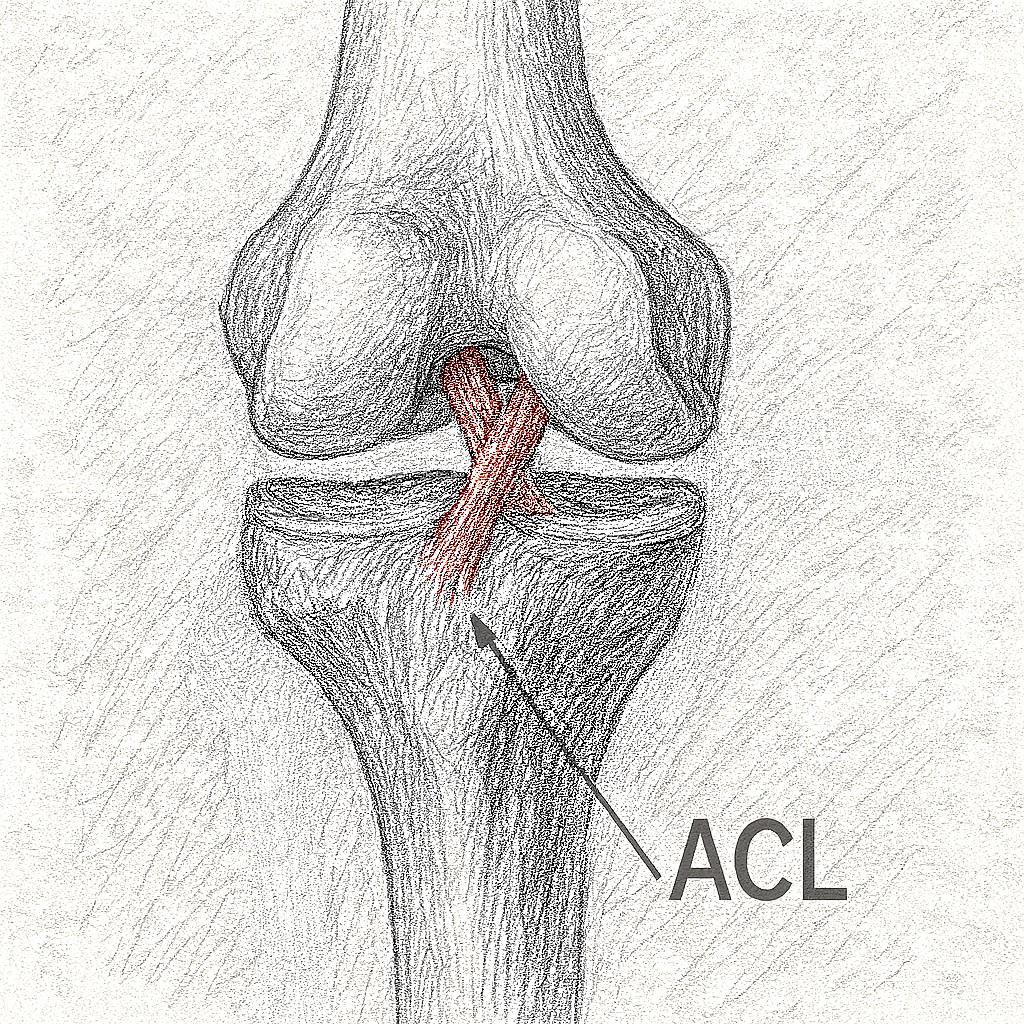
The Many Faces of Your ACL
The anterior cruciate ligament (ACL) is one of four main ligaments that stabilize your knee. Think of it as a strong rope made of collagen fibers that connects your thighbone (femur) to your shinbone (tibia) — but its job isn’t just to “hold things together.” The ACL controls how your knee moves, especially during quick stops, pivots, and jumps.
💡 Clinician Insight: The ACL is both a mechanical stabilizer and a sensory organ — it contains nerve fibers that help your brain know exactly where your knee is in space.
Where It Lives
• Origin: Inside the knee joint, attached to the back of the femur’s lateral condyle.
• Path: Runs diagonally forward and downward through the center of the knee.
• Insertion: Front part of the tibial plateau.
If you looked inside your knee during arthroscopy, the ACL would look like a small, white, twisted cord crossing in front of the posterior cruciate ligament (PCL) — which is why they’re called “cruciate,” meaning “cross-shaped.”
What It Does
1) Stops your shinbone from sliding too far forward on your thighbone.
2) Limits excessive rotation of the knee.
3) Works with other ligaments and muscles to keep movements smooth and controlled.
Real-Life Role
Picture this: You’re sprinting down a soccer field and suddenly cut to the left. Your ACL tightens to prevent the shin from sliding forward, coordinates with your hamstrings to stabilize the knee, and sends signals to your brain about position so your muscles react quickly. Without it, your knee can feel unstable — the dreaded “giving way” sensation.
Why It’s Prone to Injury
• High loads in sports: Quick pivots, awkward landings, or sudden stops create massive forces.
• Twist + bend combo: The ACL is vulnerable when the knee twists while bent.
• Biomechanics: Anatomical differences (like a narrower intercondylar notch) may increase risk.
• Neuromuscular control: Weakness or delayed firing of stabilizing muscles can overload the ACL.
Key Takeaways
• The ACL is a critical stabilizer in your knee that prevents excessive forward movement and rotation.
• It works in tandem with other ligaments, tendons, and muscles to keep your knee stable during dynamic movements.
• Understanding its anatomy helps you appreciate why prevention, treatment, and rehab are so important.
References
1) American Academy of Orthopaedic Surgeons. Anterior Cruciate Ligament (ACL) Anatomy. OrthoInfo.
2) Herzog W, et al. The Role of the Anterior Cruciate Ligament in Knee Joint Mechanics. Clin Biomech. 2019;68:58–65.
3) Zarins B, et al. Mechanisms and Pathomechanics of ACL Injury. Orthop Clin North Am. 2002;33(4):573–586.

Hi, this is a comment.
To get started with moderating, editing, and deleting comments, please visit the Comments screen in the dashboard.
Commenter avatars come from Gravatar.